The Observer and the Witness: When Quantum Measurement Meets Vedantic Consciousness
⚠️ PHILOSOPHICAL REFLECTION - NOT SCIENCE
This post explores conceptual parallels between quantum mechanics and Vedantic philosophy. These are analogies and metaphors for reflection, not scientific claims. Quantum mechanics and Vedanta have different methods (empirical observation vs. inner realization) and different goals (predictive models vs. liberation). Neither proves the other.
If you’re looking for pure quantum mechanics, check out our Quantum Measurement post. This post is for those curious about where physics and philosophy resonate—and where they diverge.
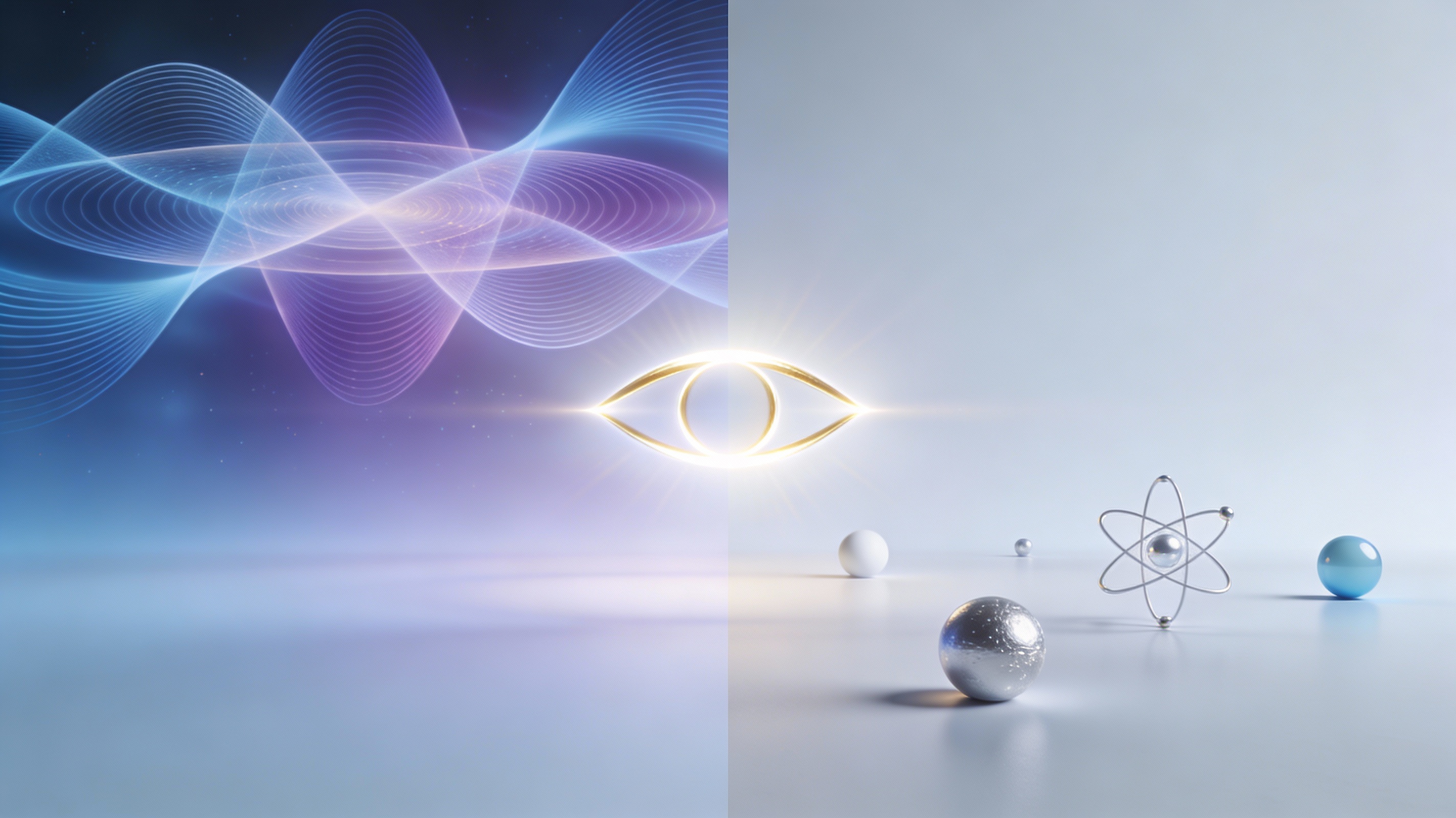
Here’s something that should bother you: the universe appears to need observers.
In quantum mechanics, until you measure a system, it exists in superposition—all possibilities coexisting. The moment you observe? The wavefunction collapses. One definite outcome emerges. Reality “chooses.”
What does observation actually do? Is it merely revealing pre-existing facts, or does it genuinely participate in creating them?
Now, here’s something else that should intrigue you: Vedantic philosophy has been asking this question for millennia.
Long before quantum mechanics shattered our certainty about objective reality, Vedanta explored the nature of consciousness, observation, and what we call “real.” It posited that ultimate reality (Brahman) is undivided consciousness—and that the appearance of separate objects, separate observers, separate “me” and “you” is Maya, a compelling illusion.
Today, we’re going to explore a striking parallel: quantum superposition and decoherence look eerily similar to Vedanta’s description of consciousness and Maya.
What if the quantum world—with its superposition, entanglement, and sudden collapse—is trying to tell us something similar to what the ancient rishis realized through meditation?
Let’s find out. But first, a reality check about what we’re not claiming.
Ground Rules: What This Post Is (and Isn’t)
This post IS:
- An exploration of conceptual parallels between quantum physics and Vedantic philosophy
- An invitation to think about consciousness, reality, and observation from multiple angles
- A demonstration that ancient wisdom and modern physics can resonate in thought-provoking ways
This post is NOT:
- A claim that quantum mechanics “proves” Vedanta
- A claim that Vedanta “predicted” quantum physics
- A scientific argument for consciousness causing wavefunction collapse
- A mixing of empirical science with spiritual practice
Quantum mechanics is an empirical science. It makes predictions. It’s verified through experiments. It doesn’t require consciousness to work—measurement means physical interaction that transfers information to the environment.
Vedanta is a philosophical and spiritual tradition. It’s about direct realization of consciousness. It’s verified through inner experience and liberation (moksha), not laboratory experiments.
Both are legitimate in their domains. Both offer insights into reality. Neither replaces the other.
With that clear, let’s explore where they resonate.
The Quantum Story: Observation Changes Everything
(If you’ve read our Quantum Measurement post, this is a quick recap. If not, here’s what you need to know.)
Before Measurement: Superposition
A quantum system—say, an electron—doesn’t have definite properties until measured. Before observation, it exists in superposition: a state that includes multiple possibilities simultaneously, described mathematically by a wavefunction.
|ψ⟩ = α|0⟩ + β|1⟩
This isn’t “we don’t know which state it’s in.” It’s “both states coexist in a specific quantum relationship.”
The electron isn’t “here or there.” It’s in a quantum superposition of being in multiple locations, described by a probability wave that spreads across space.
The Act of Measurement: Collapse
When you measure—when you ask “where is the electron?”—the superposition collapses. The wavefunction reduces to one definite outcome. You get a location. The other possibilities vanish.
Crucially: This isn’t just discovering where it was. The act of measurement forces the system to “choose” a definite state from the superposition.
Measurement is participatory, not passive.
After Measurement: Decoherence and Classicality
Here’s where it gets really interesting: your quantum system doesn’t exist in isolation. It’s constantly interacting with its environment—photons bouncing off it, air molecules colliding with it, electromagnetic fields passing through it.
Each of these interactions is a mini-measurement. They’re called decoherence—the process by which a quantum system loses its quantum properties and starts behaving classically.
Decoherence explains why you don’t see macroscopic objects in superposition. Your coffee cup isn’t in two places at once because it’s being “measured” by trillions of environmental interactions per second. The quantum coherence that enables superposition is destroyed almost instantly.
The quantum world becomes classical through continuous interaction with its environment.
Superposition → Decoherence → Classical definiteness
Keep this pattern in mind. We’ll come back to it.
The Vedantic Story: The Witness and the World
Vedanta, particularly Advaita (non-dual) Vedanta, presents a radically different picture of reality—one that’s been developed through thousands of years of contemplative inquiry.
The Fundamental Reality: Pure Consciousness (Brahman)
Vedanta posits that the ultimate reality is Brahman—pure, undifferentiated consciousness. Not consciousness “of” something, but consciousness itself. Awareness without object. Being without limitation.
Brahman is described as:
- Sat (existence/being)
- Chit (consciousness/awareness)
- Ananda (bliss/completeness)
This isn’t a “thing” you can point to. It’s the substratum of all experience. The screen on which the movie of reality plays. The awareness in which all perceptions arise.
In this view, consciousness isn’t produced by the brain. Consciousness is fundamental. The brain is an appearance within consciousness.
The Witness (Sakshi): Pure Observation
Within this framework, there’s the concept of Sakshi—the witness. This is pure observation without identification.
When you watch thoughts arise and pass, who’s watching? When you observe your emotions, who’s observing? The witness is that unchanging awareness that remains constant through all changing experiences.
Crucially: The witness doesn’t interfere. It doesn’t judge. It doesn’t participate. It simply observes. It’s awareness itself, prior to any content.
Think of it like this:
- Your thoughts are like clouds
- The witness is like the sky
- Clouds come and go, but the sky remains unchanged
The witness is consciousness in its pure, unmanifested form.
The Illusion (Maya): The Appearance of Separation
Here’s where Vedanta gets really interesting: if Brahman is the only reality—pure, undifferentiated consciousness—why do we experience a world of separate objects, separate people, separate “me” and “you”?
The answer: Maya.
Maya is often translated as “illusion,” but that’s misleading. It’s not that the world is fake or nonexistent. It’s that the appearance of separation—of multiplicity, of independent objects with definite properties—is a misperception of the underlying unity.
It’s like seeing a rope in dim light and mistaking it for a snake. The snake isn’t there, but the experience is real. The rope is real. The fear is real. But the snake? That’s Maya.
Similarly, Vedanta says:
- Brahman (pure consciousness) is real
- Your experience of the world is real
- But the appearance of separation—of “I am this body,” “you are separate from me,” “objects exist independently”—is Maya
Maya is the process by which the One appears as many.
The Forgetting: Avidya (Ignorance)
The mechanism behind Maya is Avidya—ignorance or forgetting of one’s true nature.
You are not the body. You are not the mind. You are not even the individual consciousness. You are the witness—pure awareness itself, identical with Brahman.
But through identification with the body-mind, you forget this. You start thinking “I am this person, with this history, these preferences, these limitations.”
This forgetting creates the experience of separation. Of subject and object. Of observer and observed. Of me and the world.
Avidya is consciousness forgetting itself and becoming identified with its contents.
The Parallel: Superposition, Decoherence, and the Forgetting of Unity
Now, here’s where quantum physics and Vedanta start to resonate in unexpected ways.
Let me be clear: I’m not claiming quantum superposition IS Brahman, or that decoherence IS Maya. These are different domains with different languages and different methods.
But the conceptual parallel is striking—and worth contemplating.
Parallel 1: The Fundamental State
Quantum: At the quantum level, systems exist in superposition—all possibilities coexisting in a quantum relationship. This is the “natural” quantum state before measurement.
Vedanta: At the fundamental level, there is only Brahman—undifferentiated consciousness without separation. This is the “natural” state before identification.
In both cases, there’s a primordial unity:
- Quantum: All possibilities coexist in superposition
- Vedanta: All apparent multiplicity is actually one consciousness
Parallel 2: The Act of Observation
Quantum: Measurement causes wavefunction collapse. The superposition is destroyed, and one definite outcome emerges. The observer and system become entangled—you can’t separate what you measured from how you measured it.
Vedanta: The witness (Sakshi) observes without interference, but when consciousness identifies with the body-mind (the measuring apparatus), it appears to become a separate observer. The sense of “I am observing this” creates the duality of observer and observed.
In both cases, observation creates apparent separation:
- Quantum: Measurement creates definite states from superposition
- Vedanta: Identification creates the sense of separate self
Parallel 3: Decoherence and Maya
Here’s where the parallel gets really interesting.
Quantum Decoherence:
- Your quantum system interacts with the environment
- These interactions act as continuous measurements
- Quantum coherence (superposition) is lost
- The system behaves classically—definite, separate, localized
Vedantic Maya/Avidya:
- Pure consciousness (Brahman) interacts with name and form
- These interactions create identification with the body-mind
- The awareness of unity is lost
- Experience becomes dualistic—separate objects, separate self, definite properties
The pattern is eerily similar:
Quantum World:
Superposition → Decoherence → Classical Reality
(Unity)       → (Interaction) → (Apparent Separation)

Vedantic View:
Brahman → Maya/Avidya → Perceived Multiplicity
(Unity) → (Forgetting)  → (Apparent Separation)
In quantum mechanics, decoherence explains why the quantum world appears classical—why superposition seems to disappear at macroscopic scales.
In Vedanta, Maya/Avidya explains why the unified consciousness appears as multiplicity—why the non-dual Brahman seems to fracture into separate beings and objects.
Parallel 4: The Reversibility (or Lack Thereof)
Quantum: In principle, quantum processes are reversible (unitary). If you could perfectly isolate a system and reverse all interactions, you could go from classical back to quantum. In practice, this is nearly impossible for macroscopic systems—decoherence is extremely hard to reverse.
Vedanta: In principle, anyone can realize their true nature (moksha/enlightenment). If you can “reverse” the identification with body-mind, you recognize yourself as the witness, as Brahman. In practice, this is extraordinarily difficult—lifetimes of conditioning create strong identification.
Both suggest that the “classical” or “dualistic” state isn’t the fundamental truth—it’s a derived, harder-to-escape state.
Parallel 5: Everything Is Connected
Quantum Entanglement: Two particles can become entangled such that measuring one instantly affects the other, regardless of distance. They’re not truly separate—they’re part of a unified quantum system. Local realism is violated.
Vedantic Non-Duality: All apparent separate beings are actually one Brahman appearing as many. There is no true separation—it’s all one consciousness experiencing itself through different forms. Subject-object duality is transcended.
In both views, the appearance of separate, independent entities is revealed to be incomplete:
- Quantum: Entanglement shows non-local connections
- Vedanta: Non-duality shows underlying oneness
Decoherence as Forgetting: Why We Don’t See Quantum Weirdness (Or Unity)
This parallel between decoherence and Maya/Avidya is perhaps the most thought-provoking.
Why don’t you experience quantum superposition in everyday life?
Because you—your body, your brain, your measuring apparatus—are constantly decohering. Interacting with countless environmental particles. Each interaction is a measurement that localizes you, that makes you definite, that destroys quantum coherence.
You’re too entangled with the environment to maintain quantum properties.
Why don’t you experience your true nature as Brahman in everyday life?
Because you—your sense of self, your identification—are constantly interacting with thoughts, sensations, memories, desires. Each identification reinforces the sense of separate self. Each thought “measures” you as “this person” and destroys the recognition of pure awareness.
You’re too entangled with the contents of consciousness to recognize consciousness itself.
In both cases, continuous “measurement” by the environment (physical or mental) creates the illusion of separation and definiteness.
The quantum world “forgets” its coherent, superposed nature through decoherence.
The witness “forgets” its unified, non-dual nature through Maya/Avidya.
The Classical World as a Consensus
Here’s another striking parallel: both quantum decoherence and Vedantic Maya explain why we all seem to agree on “objective reality.”
Quantum: Why do we all see the same classical world despite quantum indeterminacy? Because decoherence happens through environmental interaction. Since we’re all embedded in the same environment, we all decohere in consistent ways. The environment acts as a shared reference frame that creates consensus classical reality.
Vedanta: Why do we all experience the same empirical world despite it being Maya? Because Maya operates consistently based on karmic patterns and the gunas (qualities of nature). We’re all embedded in the same Maya, so we perceive a shared, relatively stable world. The empirical world has vyavaharika (practical) reality even though it’s not paramarthika (ultimate) reality.
Both frameworks explain:
- Why there’s an objective-seeming world
- Why that world is not the fundamental reality
- Why we all agree on its basic features
The Observer Problem: Consciousness in Quantum Mechanics?
Now for the uncomfortable question: does consciousness play a role in quantum measurement?
The Orthodox Answer (Copenhagen Interpretation): No. “Measurement” doesn’t require consciousness. It requires interaction that transfers information to the environment. A photon hitting an electron is a measurement. A thermometer measuring temperature is a measurement. No conscious observer needed.
Decoherence explains why measurement seems special—it’s just the extreme case of environmental interaction that creates definite, classical outcomes.
The Controversial Answer (Consciousness-Causes-Collapse Interpretations): Some interpretations (von Neumann-Wigner, Penrose-Hameroff) suggest consciousness might play a unique role in wavefunction collapse. These remain highly speculative and are not mainstream physics.
The Vedantic Response: Vedanta isn’t trying to explain physical measurement. It’s pointing to a different kind of observation—pure witnessing, which is awareness itself. The Sakshi doesn’t collapse wavefunctions; it’s the field in which all phenomena (including quantum phenomena and measurements) appear.
From a Vedantic view, the question “does consciousness cause collapse?” is like asking “does the screen cause the movie?” The screen doesn’t cause the movie, but the movie can’t appear without it.
My Take (Clearly Labeled as Speculation):
I don’t think quantum mechanics requires consciousness to explain measurement. Decoherence provides a perfectly adequate physical mechanism.
But I do think the quantum measurement problem—the strange role of observation in creating definite outcomes—invites us to examine our assumptions about the relationship between consciousness and reality.
Quantum mechanics demolished naive realism (the view that objects have definite properties independent of observation). Maybe that’s telling us something deeper: that the division between “observer” and “observed” is less fundamental than we thought.
Vedanta goes further: it dissolves that division entirely, showing that observer and observed are both appearances within the same consciousness.
Are these saying the same thing? No. But they’re both challenging the same assumption: that there’s a clean separation between subject and object, between consciousness and world.
And that’s worth contemplating.
Practical Implications: What Does This Mean for You?
This has been abstract. Let’s make it practical.
For Understanding Quantum Computing:
Quantum superposition is fragile. That’s why quantum computers need extreme isolation—near-absolute zero temperatures, vacuum chambers, error correction. Decoherence is the enemy. Every stray interaction with the environment destroys your quantum computation.
Understanding decoherence explains:
- Why quantum computers are so hard to build
- Why quantum states can’t be perfectly cloned
- Why measurement is destructive in quantum computing
- Why we don’t see macroscopic superposition
For Understanding Consciousness (If You’re Curious):
Your sense of separate self is fragile. That’s why meditation traditions emphasize silence, solitude, reduced sensory input. Constant mental activity reinforces identification. Every thought, every sensation pulls you back into the narrative of “me.”
Understanding Maya/Avidya explains:
- Why it’s hard to recognize your true nature
- Why moments of clarity are fleeting
- Why identification feels so compelling
- Why we don’t naturally experience non-dual awareness
The Parallel Practice:
Want to experience quantum coherence? Isolate your quantum system from the environment.
Want to experience your nature as witness? Isolate your awareness from identification with thoughts.
Both require:
- Reduction of interaction (physical or mental noise)
- Stillness (quantum isolation or meditative calm)
- Precise conditions (quantum labs or contemplative practice)
- Patience (decoherence is fast; identification is strong)
I’m not claiming these are the same thing. But the structural parallel is interesting.
Where the Analogy Breaks Down
Let’s be honest about where this parallel has limits:
1. Different Kinds of “Observation”
Quantum measurement: Physical interaction that entangles system and apparatus, transferring information to the environment.
Vedantic witness: Pure awareness without interaction, identification, or information transfer.
These are not the same. Conflating them is confused.
2. Different Verification Methods
Quantum mechanics: Verified through experiment, prediction, technological application. Falsifiable. Objective (in the sense of being intersubjectively verifiable).
Vedanta: Verified through inner realization, direct experience, liberation from suffering. Non-falsifiable. Subjective (in the sense of being first-person experience).
Neither method can validate the other. They’re different magisteria.
3. Different Goals
Quantum mechanics: Understanding physical reality to make predictions and build technology. The goal is control and application.
Vedanta: Understanding the nature of self to achieve liberation (moksha). The goal is freedom and realization.
Physics isn’t trying to liberate you. Vedanta isn’t trying to build quantum computers.
4. The Danger of Mystification
There’s a real danger in conflating quantum mechanics with consciousness or spirituality. It can lead to:
- Pseudoscience (claiming quantum mechanics validates all sorts of nonsense)
- Misunderstanding physics (thinking consciousness is required for quantum mechanics)
- Commodification of spirituality (“quantum” healing, manifestation, etc.)
- Disrespect for both traditions (using physics to “prove” spirituality, or vice versa)
This post is not doing that. I’m exploring conceptual parallels, not claiming equivalence or proof.
The Invitation: Multiple Ways of Knowing
So what’s the point of this exercise?
Not to prove anything. Not to collapse one framework into the other.
The point is to appreciate that multiple ways of inquiring into reality can reveal complementary insights.
Quantum mechanics reveals:
- Reality at the smallest scales doesn’t match our intuitions
- Observation and system are deeply connected
- The classical world emerges from quantum through decoherence
- Separation and definiteness are derived, not fundamental
Vedanta reveals:
- Consciousness as experienced doesn’t match our assumptions about it
- Witness and witnessed are not ultimately separate
- The dualistic world emerges from unity through Maya
- Multiplicity and individuality are appearances, not ultimate truth
Both are pointing at something beyond naive realism.
You don’t need Vedanta to understand quantum computing. You don’t need quantum mechanics to practice meditation.
But if you’re curious about the nature of reality, observation, and consciousness—both offer profound insights. And sometimes, exploring where they resonate can deepen your appreciation of both.
The Question That Remains
Here’s what keeps me up at night:
Why does the universe have this structure—where fundamental unity gives way to apparent multiplicity?
In quantum mechanics, why does superposition decohere into classical definiteness? Why isn’t everything just entangled superposition forever?
In Vedanta, why does Brahman manifest as Maya? Why does pure consciousness appear to fragment into separate beings? Why this cosmic game of forgetting and remembering?
Both frameworks describe the pattern. Neither fully explains why it exists.
Maybe that’s not a question physics or philosophy can answer. Maybe it’s the wrong question.
Or maybe it’s the only question that matters.
What’s Next in This Journey
This philosophical reflection was meant to make you think, not convince you of anything. If it sparked curiosity, that’s success.
Upcoming scientific posts:
- Single-qubit gates and the Bloch sphere
- Multi-qubit gates and controlled operations
- Entanglement deep dive (the physics, not the philosophy)
Upcoming philosophical reflections:
- Non-locality meets non-duality (entanglement and Advaita)
- Maya and measurement (illusion and quantum potentiality)
- The quantum-classical boundary and levels of reality
For now, I’ll leave you with this:
Whether you see quantum superposition as a mathematical description of physical systems, or as a pointer toward the non-dual nature of consciousness, or as both, or as neither—what matters is that you keep asking:
What is observation? What is reality? What am I?
The quantum world won’t answer that for you. Vedanta can’t force the realization. But both can help you ask better questions.
And sometimes, that’s enough.
Stay curious. Stay skeptical. Stay open. 🌊🕉️
Further Reading & Resources
Quantum Mechanics (Science):
- Our Quantum Measurement post for the physics without philosophy
- Wojciech Zurek’s work on decoherence (technical but illuminating)
- “The Fabric of Reality” by David Deutsch (Many-Worlds interpretation perspective)
Vedanta (Philosophy):
- “I Am That” by Nisargadatta Maharaj (direct non-dual teaching)
- “The Upanishads” translated by Eknath Easwaran (source texts)
- “Ashtavakra Gita” (radical non-duality)
The Intersection (Proceed with Caution):
- “The Tao of Physics” by Fritjof Capra (classic but controversial)
- “Quantum Questions” edited by Ken Wilber (anthology of physicists’ mystical writings)
- “The Quantum and the Lotus” by Matthieu Ricard & Trinh Xuan Thuan (Buddhism and physics dialogue)
Critical Perspective:
- “Quantum Enigma” by Rosenblum & Kuttner (physicists examining consciousness question)
- “Fashionable Nonsense” by Sokal & Bricmont (critique of misusing physics for philosophy)
Previous Post: Quantum Measurement: The Observer Effect That Changes Everything
Next Post: Single-Qubit Gates: Your First Quantum Operations (Coming soon)
Want to discuss? These ideas live at the intersection of physics, philosophy, and personal inquiry. I’d love to hear your thoughts:
- Do you find these parallels illuminating or misleading?
- What questions does this raise for you?
- Where do you think the analogy breaks down?
Connect on LinkedIn or Twitter.
📢 Follow ProbableQ on LinkedIn for more quantum insights and philosophical reflections!