Quantum Measurement: The Observer Effect That Changes Everything
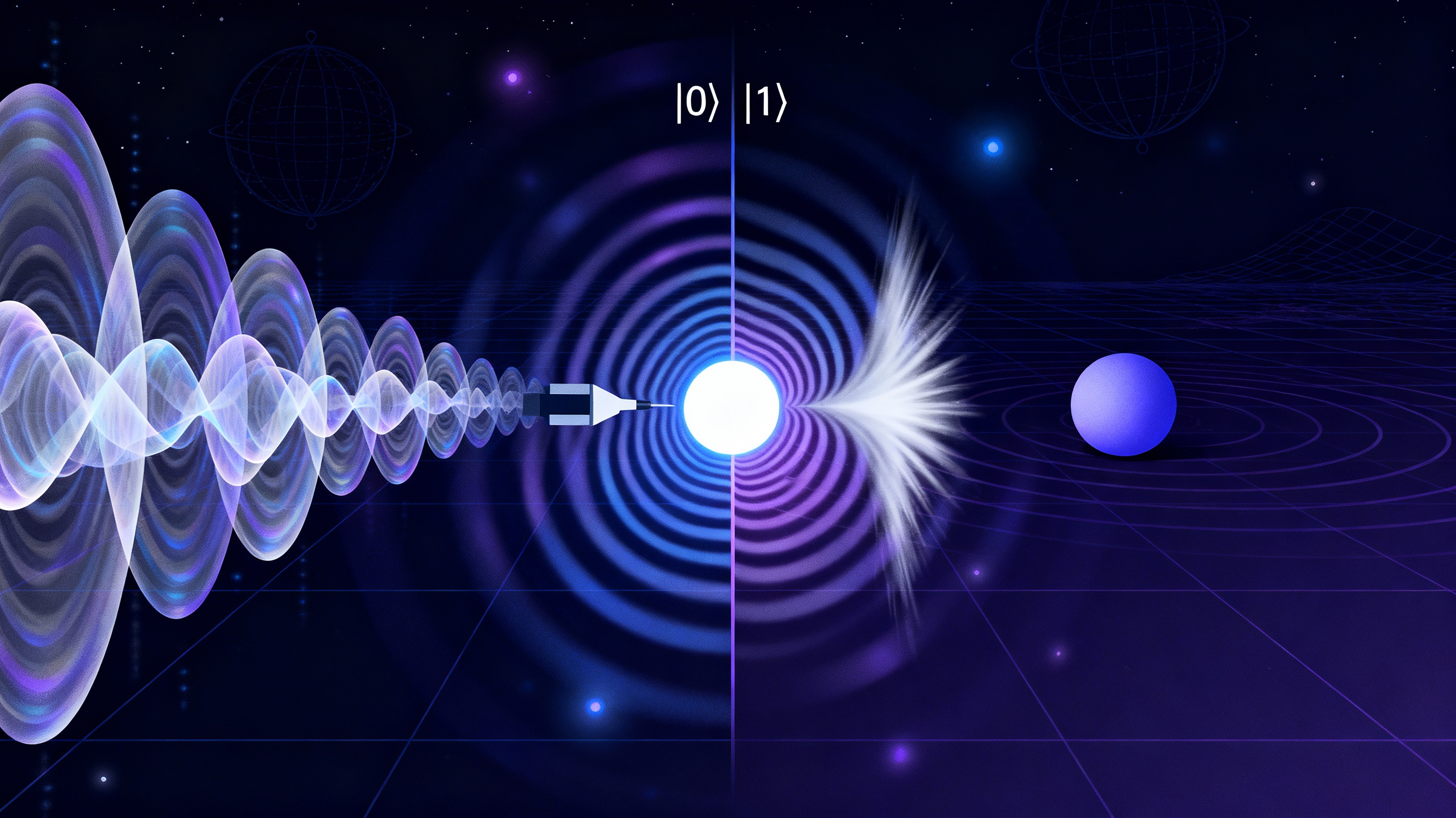
Here’s something that should bother you: looking at something changes it.
Not in the philosophical “perception shapes reality” sense. In the literal, mathematical, “the equations say this must happen” sense.
In classical physics, observation is passive. You shine light on an object, photons bounce back, you see it. The object doesn’t care. You can measure a classical bit—is it 0 or 1?—as many times as you want, and the answer stays the same.
In quantum mechanics? Observation is violence.
The moment you measure a quantum system, you force it to make a choice. The superposition collapses. The quantum information is destroyed. And you can never get it back.
This isn’t a technological limitation we’ll eventually overcome. It’s woven into the mathematical fabric of quantum mechanics itself.
Today, we’ll unpack what quantum measurement really means, why it’s so destructive, and how decoherence—the process that makes quantum systems “classical”—connects to measurement in surprising ways.
(Building on concepts from our previous posts on superposition and the no-cloning theorem, this is where quantum weirdness gets personal.)
What Is “Measurement” in Quantum Mechanics?
Let’s start with the basics. When we say “measure a quantum system,” what do we actually mean?
Classical measurement: You observe a property of a system. The system has that property before, during, and after observation. Measurement reveals pre-existing information.
Quantum measurement: You perform an interaction that forces the quantum system to “choose” a definite value from a range of possibilities encoded in its superposition. The act of measurement creates the definite outcome, not just reveals it.
Here’s the mathematical picture:
Before measurement, a qubit exists in a superposition:
|ψ⟩ = α|0⟩ + β|1⟩
Where:
αandβare complex probability amplitudes|α|²is the probability of measuring 0|β|²is the probability of measuring 1|α|² + |β|² = 1(total probability must equal 1)
The state contains both possibilities simultaneously. It’s not that the qubit is secretly 0 or 1 and we just don’t know which—it’s genuinely in a superposition of both.
(If you need a refresher on what superposition really means and why it’s not just “hidden information,” check out our earlier post.)
The Measurement Postulate
When you measure this qubit, quantum mechanics gives us a clear rule (the measurement postulate):
- The measurement outcome is probabilistic: You’ll get 0 with probability
|α|²or 1 with probability|β|² - Wave function collapse: After measurement, the superposition is destroyed. If you measured 0, the state becomes
|0⟩. If you measured 1, it becomes|1⟩. - Irreversibility: You cannot recover the original superposition state after measurement
Mathematically, if you measure 0:
|ψ⟩ = α|0⟩ + β|1⟩ --(measure)--> |0⟩
The amplitudes α and β? Gone. The quantum information? Destroyed. All you have left is a definite classical bit: 0.
The Mathematics of Measurement: Projection Operators
Let’s dig deeper into the math. How do we describe measurement formally?
In quantum mechanics, measurements are represented by operators—mathematical objects that act on quantum states. Specifically, measurements correspond to projection operators.
What is a projection operator? A projection operator is a mathematical object that “projects” a quantum state onto a specific subspace. Think of it like a filter: when you apply a projection operator to a quantum state, it extracts only the component of that state that lies in a particular direction (or subspace) of the quantum state space. The key property is that applying the projection twice gives the same result as applying it once—like projecting your shadow on the ground; projecting the shadow again doesn’t change it.
For a simple two-outcome measurement (like measuring a qubit in the computational basis), we have two projection operators:
P₀ = |0⟩⟨0| and P₁ = |1⟩⟨1|
These operators satisfy:
P₀ + P₁ = I(completeness: they cover all possibilities)P₀ P₁ = 0(orthogonality: outcomes are mutually exclusive)P₀² = P₀andP₁² = P₁(projection property)
When you measure state |ψ⟩ = α|0⟩ + β|1⟩:
Probability of outcome 0:
p(0) = ⟨ψ|P₀|ψ⟩ = |⟨0|ψ⟩|² = |α|²
Probability of outcome 1:
p(1) = ⟨ψ|P₁|ψ⟩ = |⟨1|ψ⟩|² = |β|²
Post-measurement state (if you measured 0):
|ψ'⟩ = P₀|ψ⟩ / √⟨ψ|P₀|ψ⟩ = P₀|ψ⟩ / √|α|² = |0⟩
The denominator is a normalization factor that ensures the resulting state has unit probability.
Example: Measuring a Hadamard Superposition
Let’s apply this to a concrete example. Suppose you have a qubit in an equal superposition (created by applying a Hadamard gate to |0⟩):
|ψ⟩ = (1/√2)(|0⟩ + |1⟩)
Here, α = β = 1/√2, so:
p(0) = |α|² = |1/√2|² = 1/2
p(1) = |β|² = |1/√2|² = 1/2
You have a 50% chance of measuring 0 and a 50% chance of measuring 1.
If you measure 0, the state collapses to |0⟩.
If you measure 1, the state collapses to |1⟩.
Either way, the original superposition is gone forever. You can’t reconstruct it. The quantum information about the relative phase and amplitudes has been irreversibly destroyed.
What Does “Observer” Really Mean?
Here’s where things get philosophically loaded. The term “observer effect” makes it sound like consciousness or human awareness is somehow involved in quantum mechanics.
It’s not.
In quantum mechanics, “observation” or “measurement” simply means:
Any interaction with a macroscopic apparatus that extracts classical information from a quantum system
The “observer” doesn’t need to be conscious. It can be:
- A photon detector
- A magnetic field sensor
- A screen that records particle positions
- Even another quantum system coupling to the environment
The key is that measurement involves information transfer from the quantum system to the classical world. This process is fundamentally different from quantum-to-quantum interactions, which are reversible and preserve superposition.
The von Neumann Chain
Here’s a thought experiment called the von Neumann measurement chain:
- Quantum system (qubit in superposition)
- Measuring apparatus (detector)
- Recording device (computer)
- Human observer reading the result
At what point does “measurement” happen? When the qubit interacts with the detector? When the detector records the result? When the human reads it?
The answer: somewhere between the quantum system and the macroscopic apparatus. The exact boundary is fuzzy and depends on when irreversible information transfer occurs. This is where decoherence comes in—and it’s one of the deepest unsolved questions in quantum foundations.
Decoherence: The Bridge Between Quantum and Classical
Now we get to the heart of the matter: decoherence.
Decoherence is the process by which quantum superpositions are destroyed through interaction with the environment. It explains why we don’t see macroscopic objects (like cats) in superposition, even though they’re made of quantum particles.
The Core Idea
No quantum system is perfectly isolated. Every system interacts with its environment—air molecules, thermal radiation, electromagnetic fields, etc. These interactions cause the quantum system to become entangled with the environment.
Note: We’ll dive deep into entanglement in a future post, but briefly: entanglement is a quantum correlation where measuring one system instantly affects another, no matter the distance.
When a qubit in superposition becomes entangled with environmental degrees of freedom, the superposition appears to collapse—even without a formal “measurement.”
The Mathematics of Decoherence
Let’s make this concrete. Suppose you have a qubit in superposition:
|ψ⟩_system = α|0⟩ + β|1⟩
And an environment initially in state |E₀⟩. The combined system-environment state is:
|Ψ_initial⟩ = (α|0⟩ + β|1⟩) ⊗ |E₀⟩
Now, the system interacts with the environment. The key is that the environment responds differently depending on the system’s state. After interaction:
|Ψ_final⟩ = α|0⟩ ⊗ |E₀'⟩ + β|1⟩ ⊗ |E₁'⟩
Where |E₀'⟩ is the environment state when the system is in |0⟩, and |E₁'⟩ is the environment state when it’s in |1⟩.
Crucially: If |E₀'⟩ and |E₁'⟩ are nearly orthogonal (i.e., very different), the environment has effectively “measured” the system.
The Reduced Density Matrix
To see what happens to the system alone, we use the density matrix formalism and “trace out” the environment.
What is a density matrix? While a wave function |ψ⟩ describes a pure quantum state, a density matrix is a more general mathematical tool that can describe both pure states and mixed states (statistical mixtures of quantum states). Think of it as a 2×2 table (for a qubit) that encodes all the information about the quantum state. For a pure superposition like |ψ⟩ = α|0⟩ + β|1⟩, the density matrix ρ = |ψ⟩⟨ψ| contains both the probabilities (diagonal terms: |α|² and |β|²) and the quantum coherence information (off-diagonal terms: how the states interfere). When we “trace out” the environment, we’re essentially averaging over all the environmental states we can’t observe, which often kills the off-diagonal coherence terms.
Before decoherence, the system’s density matrix is:
ρ_system = |ψ⟩⟨ψ| = |α|²|0⟩⟨0| + α*β|0⟩⟨1| + αβ*|1⟩⟨0| + |β|²|1⟩⟨1|
If you write this as a 2×2 matrix, it looks like:
ρ = [ |α|²      α*β   ]
    [ αβ*      |β|²   ]
Understanding diagonal vs. off-diagonal terms:
The diagonal terms (|α|² and |β|²) sit on the main diagonal (top-left to bottom-right). These are always real, positive numbers that represent the classical probabilities: the probability the qubit is in state |0⟩ is |α|², and the probability it’s in |1⟩ is |β|². Even a classical system that’s randomly either 0 or 1 would have these diagonal terms.
The off-diagonal terms (α*β and αβ*) sit off the main diagonal (top-right and bottom-left). These are generally complex numbers that encode something purely quantum: coherence. They represent the fact that the quantum amplitudes α and β have a definite phase relationship—they can interfere with each other, like waves. These terms capture the “quantumness” of superposition. If the off-diagonal terms are non-zero, the system is in a genuine quantum superposition. If they’re zero, the system behaves classically—it’s just a statistical mixture.
Concrete example: For the equal superposition |ψ⟩ = (1/√2)(|0⟩ + |1⟩), where α = β = 1/√2:
- Diagonal:
|α|² = |β|² = 1/2(50% chance of each outcome) - Off-diagonal:
α*β = (1/√2)(1/√2) = 1/2(strong quantum coherence)
The off-diagonal terms |0⟩⟨1| and |1⟩⟨0| represent quantum coherence—the fact that the system is in a superposition.
After decoherence (tracing over the environment):
ρ_system' = |α|²|0⟩⟨0| + |β|²|1⟩⟨1|
The off-diagonal terms vanish. The system now behaves like a classical mixture: it’s either 0 with probability |α|² or 1 with probability |β|², but it’s no longer in a superposition.
This is called a mixed state, as opposed to the original pure state. From the system’s perspective, the superposition has collapsed—even though no explicit measurement was performed.
Decoherence Timescale
How fast does decoherence happen? It depends on:
- Strength of system-environment coupling
- Number of environmental degrees of freedom
- Temperature
For a single qubit in a quantum computer, typical decoherence times are:
- Superconducting qubits: 10–100 microseconds
- Ion trap qubits: milliseconds to seconds
- Photonic qubits: can be very long (limited by detection efficiency)
For macroscopic objects? Decoherence is instantaneous on any measurable timescale. This is why you never see Schrödinger’s cat in superposition—the environment decoheres it immediately.
Measurement vs. Decoherence: What’s the Difference?
Here’s a subtle but important distinction:
Decoherence:
- System becomes entangled with environment
- Superposition appears to collapse from the system’s perspective
- The total system+environment state is still a pure quantum state
- Reversible in principle (if you could track and reverse all environmental interactions)
Measurement:
- Irreversible information extraction
- Classical outcome is recorded
- Truly non-reversible in practice
Decoherence explains why measurement-like behavior happens when quantum systems interact with large environments. It’s the mechanism behind wave function collapse—though whether decoherence fully solves the measurement problem is still debated among physicists.
The Measurement Problem: Why This Is Still Controversial
Despite a century of quantum mechanics, the measurement problem remains one of the deepest puzzles in physics:
If quantum mechanics describes everything with a deterministic wave function evolution (the Schrödinger equation), why do measurements produce random, definite outcomes?
Different interpretations of quantum mechanics offer different answers:
1. Copenhagen Interpretation
Measurement is a fundamental, irreducible part of quantum mechanics. The wave function collapses upon measurement, and that’s just how nature works. Don’t ask why.
2. Many-Worlds Interpretation
The wave function never collapses. Every measurement outcome occurs in a different branch of the universe. You experience one outcome, but all outcomes happen.
|ψ⟩ = α|0⟩ + β|1⟩ --> α|0⟩|observer sees 0⟩ + β|1⟩|observer sees 1⟩
Both branches exist; you just perceive one.
3. Decoherence-Based Interpretations
Decoherence explains the appearance of collapse by showing how superpositions become effectively classical through environmental interaction. The measurement problem is resolved (or at least softened) by recognizing that observers are part of the environment.
4. Objective Collapse Theories
The wave function actually collapses spontaneously when systems reach certain thresholds (mass, complexity, etc.). Measurement is just a special case of this physical process.
We won’t resolve this debate here—physicists haven’t resolved it in 100 years! But understanding the problem is crucial for thinking clearly about quantum mechanics.
Why Measurement Matters for Quantum Computing
All this philosophy aside, why does measurement matter for quantum computing?
1. Measurement Is Your Output
Quantum algorithms manipulate superpositions and entanglement to encode answers. But at the end, you must measure to extract the result. Measurement converts quantum information back into classical bits you can read.
The art of quantum algorithm design is engineering the superposition so that measurement gives you the answer with high probability.
2. Measurement Is Destructive
Once you measure, the quantum state is gone. You can’t measure halfway through an algorithm without destroying the computation. This makes debugging quantum programs incredibly difficult—you’re flying blind until the final measurement.
(This connects directly to the no-cloning theorem—you can’t copy the state to inspect it without disturbing it.)
3. Decoherence Is the Enemy
Quantum computers must maintain superposition long enough to run the algorithm. But decoherence is constantly trying to collapse the state through environmental interaction.
This is why quantum computers require:
- Isolation: Cryogenic cooling, vacuum chambers, magnetic shielding
- Error correction: Quantum error correction codes that protect against decoherence
- Fast operations: Complete the computation before decoherence destroys it
The race is between gate speed (how fast you can perform quantum operations) and decoherence time (how long the qubit stays quantum).
A Concrete Example: Measuring in Different Bases
Here’s where measurement gets really interesting. You can choose which property to measure, and different choices give you different information.
Computational Basis Measurement
The standard measurement: is the qubit |0⟩ or |1⟩?
For state |ψ⟩ = (1/√2)(|0⟩ + |1⟩), you get 0 or 1 with equal probability.
Hadamard Basis Measurement
But what if you measure in the Hadamard basis: |+⟩ = (1/√2)(|0⟩ + |1⟩) and |-⟩ = (1/√2)(|0⟩ - |1⟩)?
First, express |ψ⟩ in this basis:
|ψ⟩ = (1/√2)(|0⟩ + |1⟩) = |+⟩
Now if you measure in the Hadamard basis, you get |+⟩ with 100% probability!
Same state, different measurement, different result.
This is a fundamental feature of quantum mechanics: measurement choice matters. Different measurements are incompatible—you can’t measure both the computational basis and Hadamard basis simultaneously with certainty.
This is the quantum uncertainty principle in action.
The Zeno Effect: Watching the Pot Never Boils
Here’s a mind-bending consequence of measurement: the quantum Zeno effect.
If you measure a quantum system repeatedly, the measurements themselves prevent it from evolving.
Suppose a system starts in state |0⟩ and would naturally evolve to |1⟩ over time. If you continuously measure whether it’s still in |0⟩, each measurement collapses it back to |0⟩, preventing the transition.
Mathematically, frequent measurements “freeze” the quantum state because each collapse resets the evolution.
This is the quantum version of the watched pot never boiling—except it’s literally true.
Practical Measurement: How Do We Actually Do It?
In real quantum computers, how do we perform measurements?
Superconducting Qubits
Apply a microwave pulse and measure the reflected signal. The reflection depends on the qubit’s state, allowing you to distinguish |0⟩ from |1⟩.
Ion Traps
Shine a laser on the ion. If it’s in state |0⟩, it fluoresces (emits photons). If it’s in |1⟩, it doesn’t. Count the photons.
Photonic Qubits
Use photodetectors to detect the presence or absence of photons, or measure polarization with beam splitters and detectors.
All these methods share a common feature: amplification. A single quantum event (qubit state) triggers a macroscopic, measurable signal (voltage, photon count, etc.). This amplification is what makes measurement irreversible and classical.
The Philosophical Angle: What Does Measurement Tell Us About Reality?
The measurement problem raises profound questions:
Does the quantum state represent objective reality, or just our knowledge?
If it’s objective reality, how can observation change it? If it’s just knowledge, why does quantum mechanics work so well?
Is reality fundamentally probabilistic, or deterministic with hidden variables?
Bell’s theorem is one of the most profound results in physics. It addresses the question: “Is quantum randomness real, or are there hidden variables we just can’t see?” Einstein famously believed in hidden variables—that particles have definite properties all along, and quantum mechanics just doesn’t tell us what they are (“God does not play dice”).
Bell showed mathematically that if hidden variables exist and obey locality (no faster-than-light influence), then certain statistical correlations between entangled particles must satisfy an inequality (Bell’s inequality). But quantum mechanics predicts violations of this inequality. Experiments have repeatedly confirmed quantum mechanics: Bell’s inequality is violated in nature. This means either:
- Hidden variables don’t exist (quantum randomness is fundamental), or
- Locality is violated (measuring one particle instantly affects another, even at a distance)
Most physicists accept the first option. Quantum randomness seems fundamental.
What is the role of the observer?
Is consciousness required for collapse? (Almost certainly not—most physicists reject this.) Or is measurement purely physical, a matter of information transfer and decoherence?
Philosophical aside: These questions resonate with ancient debates in Vedantic philosophy about the nature of reality and the role of the observer. In Advaita Vedanta, the distinction between observer (seer) and observed (seen) is considered ultimately illusory—both are aspects of one non-dual consciousness (Brahman). While quantum mechanics doesn’t prove Vedanta (and vice versa), both frameworks challenge naive realism and ask deep questions about observation, reality, and the nature of knowledge. We’ll explore these parallels in our upcoming philosophical reflection post.
The Bottom Line
Quantum measurement is fundamentally different from classical observation:
- Measurement forces definite outcomes from superpositions, probabilistically
- Wave function collapse is irreversible and destructive
- Decoherence explains how quantum systems become classical through environmental interaction
- The measurement problem remains one of physics’ deepest puzzles
- For quantum computing, measurement is both the final output and the enemy of quantum coherence
Understanding measurement is crucial for grasping why quantum computing is hard, why qubits are fragile, and why quantum information is so different from classical information.
The quantum world is a superposition of possibilities. Measurement forces a choice. And once chosen, there’s no going back.
What’s Next?
Now that you understand measurement and decoherence, you’re ready for our next philosophical reflection: “The Observer and the Witness: Quantum Measurement Meets Vedantic Consciousness”
We’ll explore:
- The role of observation in quantum mechanics and Vedanta
- Consciousness as witness (Sakshi) vs. physical measurement
- Why quantum mechanics doesn’t require conscious observers
- Conceptual parallels between wave function collapse and Maya (appearance vs. reality)
This will be a bridge between the hard science we’ve covered and deeper questions about observation, consciousness, and reality.
After that, we’ll dive into single-qubit gates—the Hadamard, Pauli, and phase gates that manipulate quantum states on the Bloch sphere.
Stay curious.
References and Further Reading
Original Papers and Foundational Texts
- von Neumann, J. (1932). Mathematische Grundlagen der Quantenmechanik (Mathematical Foundations of Quantum Mechanics). Springer.
- The first rigorous treatment of the measurement problem and projection postulate
- Zurek, W. H. (2003). “Decoherence, einselection, and the quantum origins of the classical.” Reviews of Modern Physics, 75(3), 715-775. https://doi.org/10.1103/RevModPhys.75.715
- The definitive paper on decoherence and how classical reality emerges from quantum mechanics
- Schlosshauer, M. (2007). Decoherence and the Quantum-To-Classical Transition. Springer.
- Comprehensive textbook on decoherence theory
Books and Learning Resources
- Nielsen, M. A., & Chuang, I. L. (2010). Quantum Computation and Quantum Information (10th Anniversary Edition). Cambridge University Press.
- See Chapter 2 for measurement postulates and Chapter 8 for decoherence in quantum computing
- Griffiths, D. J., & Schroeter, D. F. (2018). Introduction to Quantum Mechanics (3rd Edition). Cambridge University Press.
- Excellent introduction to measurement theory and wave function collapse
- Thomas, A. H. Hidden In Plain Sight 10: How To Program A Quantum Computer. https://www.goodreads.com/book/show/41428716-hidden-in-plain-sight-10
- Practical perspective on measurement in quantum computing
Interactive Tools
- IBM Quantum Composer: Experiment with measurements on real quantum computers at https://quantum-computing.ibm.com/composer
- Qiskit Textbook: Free tutorials on quantum measurement at https://qiskit.org/learn
Previous Posts in This Series
- Why Boolean Logic Fails in Quantum Computing
- The Double-Slit Experiment
- Superposition Explained: Why Qubits Aren’t Just Fancy Coins
- The No-Cloning Theorem: Why You Can’t Copy-Paste Quantum Information
Next Post: The Observer and the Witness: Quantum Measurement Meets Vedantic Consciousness (Philosophical Reflection - Coming soon)
📢 Stay Updated: Follow ProbableQ on LinkedIn for more quantum computing insights and updates on this blog series!
Have questions or insights? Connect with me on LinkedIn or Twitter.