The Double-Slit Experiment: When Reality Refuses to Make Sense
Before we dive deeper into quantum computing, we need to confront the experiment that shattered our understanding of reality itself: the double-slit experiment.
This isn’t just another physics demonstration. This is the experiment that forced us to accept that nature operates in ways that fundamentally contradict our everyday intuition. As physicist Richard Feynman famously said, the double-slit experiment contains “the only mystery” of quantum mechanics—everything else is just commentary.
Today, we’re going to walk through this experiment step by step, following the approach beautifully laid out in Andrew Thomas’s Hidden In Plain Sight 10. We’ll make reasonable assumptions about what’s happening, then watch those assumptions get systematically demolished by experimental evidence.
By the end, you’ll understand why quantum superposition isn’t just a mathematical convenience—it’s the only way to explain what we actually observe.
The Setup: A Seemingly Simple Experiment
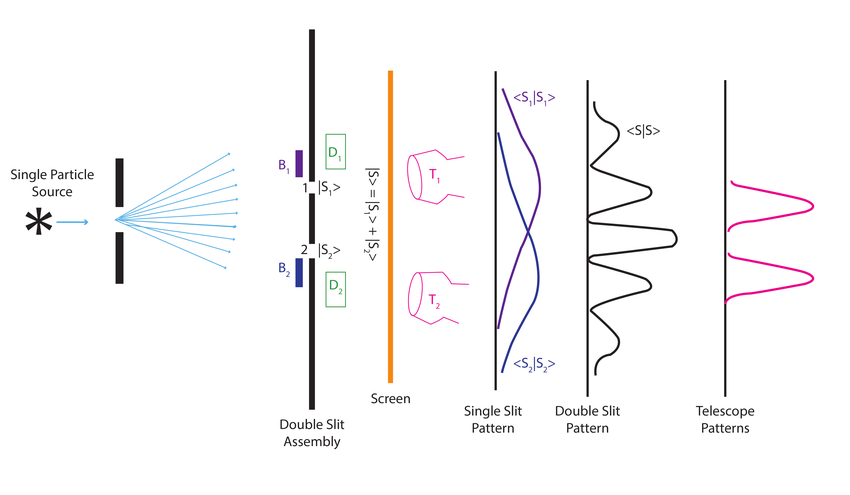
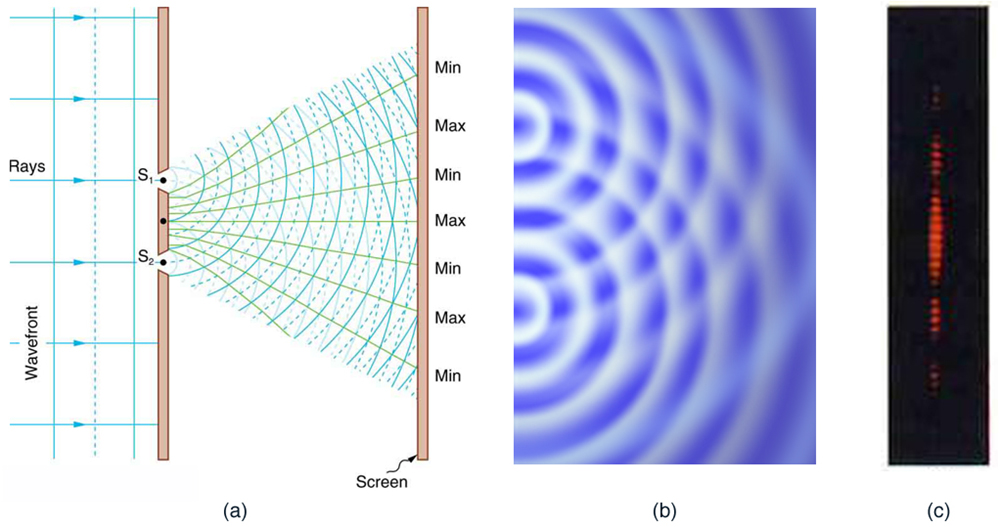 Basic setup: particle source, barrier with two slits, and detection screen
Imagine you have:
- A source that shoots particles (let’s say electrons) one at a time
- A barrier with two narrow slits in it
- A detection screen behind the barrier that lights up wherever a particle hits
The question: What pattern appears on the screen after many particles have been fired?
Seems straightforward, right? Let’s see what happens.
Attempt 1: “Particles Go Through One Slit or the Other”
The Reasonable Assumption: Each particle is a tiny bullet. It goes through either the left slit OR the right slit. After many particles, we should see two bright bands on the screen—one behind each slit, maybe with some spread due to scattering.
What Actually Happens: We see an interference pattern—multiple alternating bright and dark bands across the screen. Not two bands. Many bands. And the pattern looks exactly like what you’d get if waves (not particles) were passing through both slits simultaneously and interfering with each other.
Unexpected result: Multiple bright and dark bands form an interference pattern
Bright bands appear where waves from the two slits constructively interfere (peaks align).
Dark bands appear where waves destructively interfere (peak meets trough, canceling out).
The Problem: If each particle goes through only one slit, how does it “know” about the other slit to create this interference pattern? A particle going through the left slit shouldn’t care whether the right slit is open or closed. But somehow, it does.
Attempt 2: “Okay, Maybe Each Particle Goes Through Both Slits?”
The New Assumption: Fine, maybe each particle somehow splits or spreads out and goes through both slits simultaneously. That would explain the interference pattern—the particle interferes with itself.
The Test: Let’s close one slit and see what happens.
What Actually Happens: The interference pattern disappears. We now get a single bright band (with some spread) directly behind the open slit. This is exactly what we’d expect for particles going through one slit.
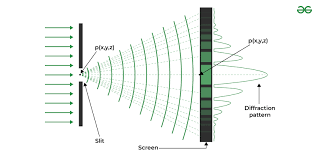 With one slit closed: interference pattern vanishes, leaving a single band
Wait, What? When both slits are open: interference pattern (wave behavior). When one slit is closed: single band (particle behavior).
So closing a slit doesn’t just reduce the pattern—it fundamentally changes it. The particle seems to “know” whether one or both slits are open and behaves differently accordingly.
Attempt 3: “Let’s Watch Which Slit the Particle Goes Through”
The Clever Idea: Place detectors right at the slits to catch the particle in the act. We’ll definitively see which slit each particle goes through, settling this once and for all.
What Actually Happens: The moment you add detectors at the slits:
- The detectors always register the particle at ONE slit or the OTHER—never both simultaneously
- The interference pattern on the screen DISAPPEARS
- We’re back to seeing two simple bands, one behind each slit
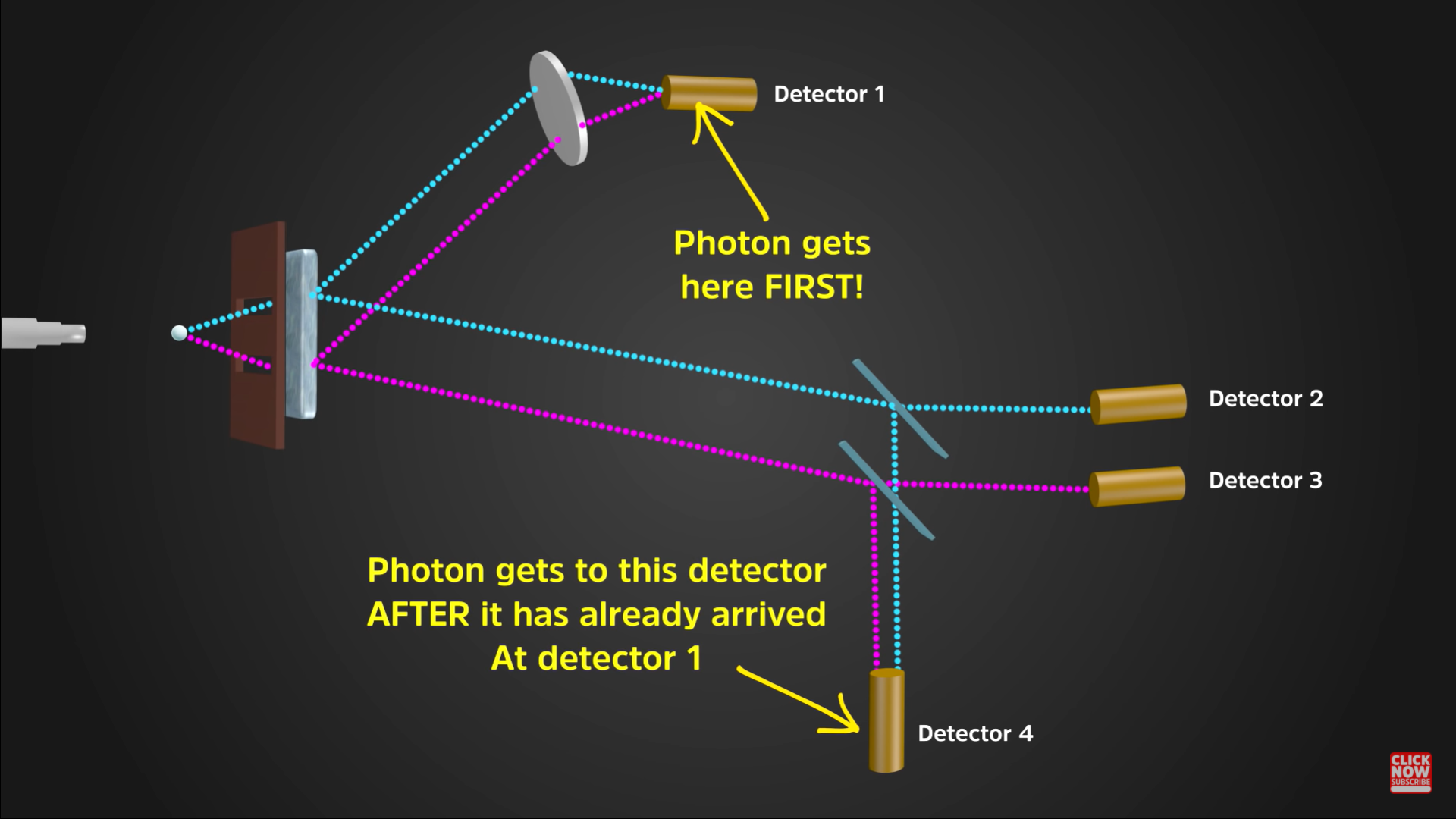 With detectors at slits: particle chooses one path, interference pattern disappears
The Mind-Bending Implication: When you’re not looking (no detectors at slits): interference pattern appears, as if the particle went through both slits. When you are looking (detectors at slits): the particle goes through one slit, and the interference pattern vanishes.
The act of observing—of measuring which slit the particle goes through—fundamentally changes what happens. It’s not that we’re disturbing the particle with clumsy detectors. Even extremely gentle detection methods yield the same result. The measurement itself changes reality.
Attempt 4: “Maybe We Can Outsmart It—Delayed Choice”
The Even Cleverer Idea: What if we let the particle pass through the slits first, and then decide whether to measure which slit it went through? Surely the particle has already “chosen” its path by then, right?
The Experiment (Wheeler’s Delayed Choice): Fire the particle. After it passes through the slits but before it hits the screen, quickly insert or remove the detection mechanism that determines which path it took.
What Actually Happens: If you insert detectors to measure the path: you see particle behavior (no interference). If you don’t measure the path: you see wave behavior (interference pattern).
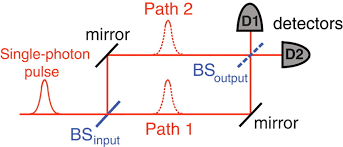 Delayed choice: Decision to measure made after particle passes through slits still affects the outcome
This holds true even if you make the decision after the particle has passed through the slits. It’s as if the particle “retroactively decides” whether it went through one slit or both, based on your future measurement choice.
Attempt 5: “Firing One Particle at a Time Will Solve This”
The Last Hope: Maybe particles are somehow interfering with each other. Let’s fire them one at a time, with large gaps between each particle, so no particle can possibly interact with another.
What Actually Happens: Single particles still create the interference pattern—gradually. Each particle hits the screen at one location (a dot appears). But after thousands of particles, the dots build up to form the same multi-band interference pattern.
 One particle at a time: Individual dots gradually form the interference pattern
The Inescapable Conclusion: Each individual particle is somehow interfering with itself. When both slits are open and unobserved, a single particle acts as if it simultaneously explores both paths, interferes with itself, and then appears at one location on the screen according to the interference probability pattern.
This is not a figure of speech. This is what the math and experiments tell us.
What the Double-Slit Experiment Really Shows
After systematically eliminating every reasonable classical explanation, we’re left with something that defies human intuition:
Before measurement: The particle exists in a quantum superposition—it’s genuinely taking both paths simultaneously. Not “we don’t know which path,” but rather “both paths at once” in a quantum sense. This superposition creates interference.
After measurement: The superposition collapses. The particle is now definitely in one path or the other. The interference disappears because there’s no longer a superposition to create it.
The mathematical description from quantum mechanics is:
|ψ⟩ = (1/√2)|left slit⟩ + (1/√2)|right slit⟩
This isn’t saying “the particle is at the left slit OR the right slit and we just don’t know which.” It’s saying “the particle is in a superposition state that includes both possibilities with specific probability amplitudes.”
Only when you measure does this collapse to:
|ψ⟩ = |left slit⟩ OR |ψ⟩ = |right slit⟩
Why This Matters for Quantum Computing
The double-slit experiment isn’t just a curiosity—it’s the foundation for understanding quantum computing:
-
Superposition is real: Qubits genuinely exist in superpositions of states, just as particles genuinely take both paths through the slits.
-
Interference is computational: The interference pattern demonstrates how quantum amplitudes add and cancel. Quantum algorithms exploit this same interference to amplify correct answers and cancel wrong ones.
-
Measurement changes everything: Just as observing the particle collapses the superposition, measuring a qubit collapses its quantum state. This is why quantum computing is so different from classical computing.
-
Quantum parallelism has limits: The particle explores both paths, but when you measure, you get one result. Similarly, qubits explore many computational paths simultaneously, but measurement yields one answer—carefully orchestrated to be the right one.
The Uncomfortable Truth
The double-slit experiment forces us to accept something profoundly strange: the universe doesn’t work the way our everyday experience suggests.
There is no classical explanation that fits all the experimental evidence. Particles are not tiny billiard balls following definite trajectories. They exist in superpositions of possibilities until measured. And somehow, the act of measurement—of extracting information—makes the quantum world “choose” a definite reality.
Different interpretations of quantum mechanics handle this differently:
- Copenhagen interpretation: The wavefunction is real and collapses upon measurement
- Many-worlds interpretation: Every possibility actually happens in branching parallel universes
- Pilot wave theory: Hidden variables guide particles through definite paths we can’t observe
But regardless of interpretation, the experimental facts remain: quantum superposition is real, measurement is special, and the universe operates in ways that transcend classical logic.
The Philosophical Edge: What Is “Real”?
Here’s where it gets even stranger. Before measurement, what “is” the particle? It’s not at the left slit. It’s not at the right slit. It’s not “at both slits” in a classical sense. It’s in a quantum superposition that doesn’t correspond to any classical picture we can draw.
Is this superposition “real”? Well, it has physical consequences (the interference pattern). You can do calculations with it that predict experimental outcomes with extraordinary precision. In what sense is something that affects physical reality not real?
Perhaps the problem is our notion of “real” itself. We assume reality consists of definite things in definite places with definite properties. Quantum mechanics suggests that at the fundamental level, reality is better described as a field of possibilities that crystallizes into definite outcomes only when observed.
(We’ll explore how this quantum view of reality—where the observer plays a central role—relates to Vedantic concepts of consciousness and the nature of existence in upcoming philosophical reflection posts. The parallels are striking.)
Try It Yourself (Virtually)
Want to play with the double-slit experiment yourself? Check out these interactive simulations:
- PhET Interactive Simulations - Quantum Wave Interference
- Adjust slit widths, add detectors, and watch how the pattern changes in real-time
The Bottom Line
The double-slit experiment proves that:
- Quantum superposition is not a mathematical trick—it’s how nature works
- Particles don’t follow definite paths until measured
- Observation fundamentally changes physical systems
- The quantum world operates by rules that have no classical analog
Understanding this experiment—really understanding it—is your gateway to understanding why quantum computing works, why qubits are so different from classical bits, and why the quantum world requires entirely new ways of thinking.
No classical explanation survives contact with the experimental evidence. Every reasonable assumption gets demolished. And we’re left with quantum mechanics—strange, counterintuitive, yet experimentally verified to extraordinary precision.
What’s Next?
Now that you’ve seen how particles exist in superposition (both slits simultaneously), you’re ready to explore what happens when we try to copy quantum information.
Spoiler: nature forbids it. The no-cloning theorem is one of quantum mechanics’ most surprising constraints, with profound implications for quantum computing and cryptography.
Why can’t you copy a quantum state? And how does this limitation actually become a feature in quantum protocols? That’s coming up next.
Stay curious—and prepare to have your intuition shattered again. 🌊
Further Reading
- Hands-On: Hidden In Plain Sight 10: How To Program A Quantum Computer by Andrew H. Thomas—Chapter 1 provides an excellent walkthrough of the double-slit experiment with clear explanations
- Classic: Richard Feynman’s lectures on the double-slit experiment (available in The Feynman Lectures on Physics, Volume III)
- Interactive: Try the PhET quantum wave interference simulation yourself
Previous Post: Superposition Explained: Why Qubits Aren’t Just Fancy Coins
Next Post: The No-Cloning Theorem: Why You Can’t Copy-Paste Quantum Information (Coming soon)
📢 Stay Updated: Follow ProbableQ on LinkedIn for more quantum computing insights and updates on this blog series!
Have questions or insights? Connect with me on LinkedIn or Twitter.