Why Your Classical AND Gates Won't Work in Quantum Computing
Welcome to the first post in this quantum computing series! If you’re wondering why we’re starting with Boolean logic instead of jumping straight into the quantum stuff—well, you can’t appreciate how weird quantum computing is until you understand what it’s not. And what it’s not is classical computing, which is built entirely on Boolean logic.
Boolean logic is the foundation of every computer you’ve ever touched. It’s the DNA of digital systems. So before we explore the strange world of qubits and superposition, we need to understand what makes classical computing tick—and why those same principles spectacularly fail in the quantum realm.
Here’s a fun fact: every digital device you’ve ever used—your laptop, smartphone, smart fridge—runs on the same fundamental principle that George Boole figured out in 1847. Boolean logic, with its clean TRUE and FALSE states, is the bedrock of classical computing. It’s elegant, intuitive, and it just works.
Until you try to build a quantum computer.
Then everything falls apart in the most fascinating way possible.
Boolean Logic 101: The Language of Classical Computers
Let’s start with what we know. Classical computing is built on Boolean logic, which operates on binary values: 0 and 1, FALSE and TRUE, OFF and ON. Think of a light switch—it’s either flipped up or down. No in-between, no ambiguity.
This binary foundation gives us logic gates: simple operations that take binary inputs and produce binary outputs. The three fundamental gates are:
- NOT gate: Flips the input (0 becomes 1, 1 becomes 0)
- AND gate: Returns 1 only if both inputs are 1
- OR gate: Returns 1 if at least one input is 1
Here’s a quick truth table for an AND gate:
| Input A | Input B | Output |
|---|---|---|
| 0 | 0 | 0 |
| 0 | 1 | 0 |
| 1 | 0 | 0 |
| 1 | 1 | 1 |
Beautiful in its simplicity. You can build any computation—from calculating your taxes to rendering the latest video game—by chaining together millions (or billions) of these gates. Every conditional statement in your code, every comparison, every decision ultimately boils down to Boolean operations on definite 0s and 1s.
The key word here is definite. At any given moment, a classical bit is in exactly one state: 0 or 1. You can check it, copy it, measure it a million times, and you’ll always get the same answer.
This definiteness is both classical computing’s greatest strength and the reason it can’t handle quantum information.
The Quantum Problem: When Bits Become Fuzzy
Enter the qubit, quantum computing’s answer to the classical bit. At first glance, qubits seem similar—they can represent 0 or 1. But here’s where things get weird: before you measure a qubit, it exists in a superposition of both states simultaneously.
Imagine replacing your light switch with a dimmer. When the dimmer is at 50%, the light isn’t “sort of on” in the classical sense—it’s legitimately in a state that combines “on” and “off” with specific probabilities. That’s superposition, and it fundamentally breaks our Boolean assumptions.
(Don’t worry—we’ll dive deep into superposition and what it actually means mathematically in a future post. For now, just know that it’s not simply “both states at once” but something far more subtle.)
Let’s see why classical Boolean gates fail with qubits:
Problem 1: No Definite Inputs
Boolean logic assumes you know the exact state of your inputs. An AND gate expects Input A to be either 0 or 1, and Input B to be either 0 or 1. But a qubit might be 70% likely to be 0 and 30% likely to be 1. What does “0 AND 30%-1” even mean? Classical gates simply don’t have a framework for this.
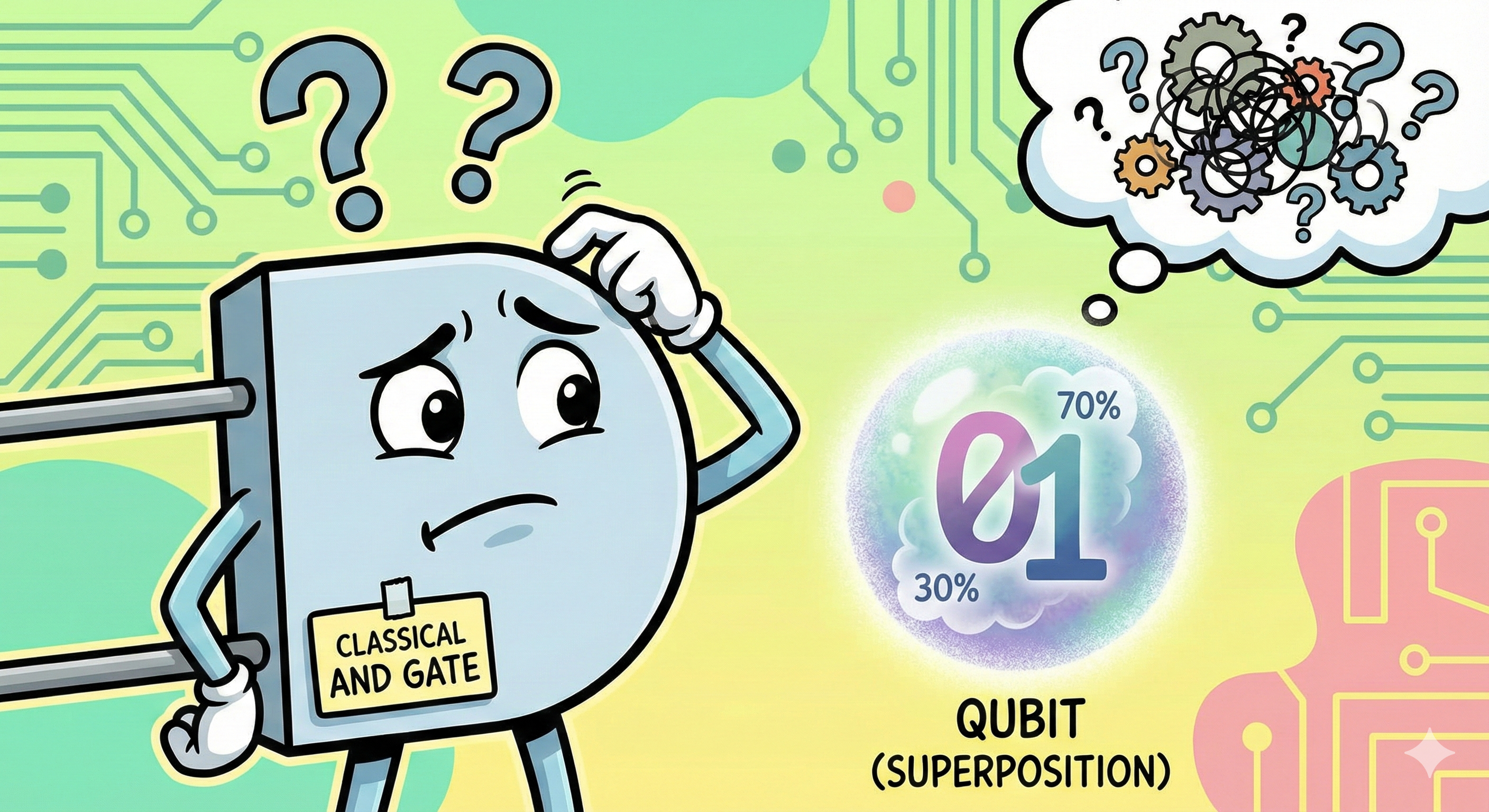
When you try to feed qubits in superposition into a classical AND gate, things get… confused.
Problem 2: Measurement Destroys Information
Here’s the real kicker: the moment you measure a qubit to check if it’s 0 or 1, the superposition collapses. You get a definite answer (say, 0), but you’ve permanently destroyed the quantum information about the probabilities that existed before measurement.
Classical computing is all about copying and checking values. You can read a bit’s value without changing it. You can duplicate it. You can verify intermediate results. Quantum mechanics says “nope” to all of that. Measuring is destructive, and the no-cloning theorem means you can’t even make a backup copy of an unknown quantum state.
(We’ll explore the no-cloning theorem and its profound implications for quantum computing in an upcoming post—it’s one of the most surprising constraints in quantum mechanics.)
Problem 3: Information Loss Is Forbidden
Most classical logic gates are irreversible. An AND gate with output 0 could have come from three different input combinations: (0,0), (0,1), or (1,0). If you only see the output, you can’t reconstruct the inputs. Information has been lost.
In quantum computing, this is a dealbreaker. The laws of quantum mechanics demand that operations be reversible (technically, unitary). If you can’t run the operation backward to recover the original state, it’s not a valid quantum operation. This immediately rules out most classical gates.
Think of it like this: classical computing is okay with one-way doors that lock behind you. Quantum computing insists every door must be able to swing both ways.
(The concept of unitary operations and why they must be reversible is crucial to understanding quantum algorithms—we’ll unpack this in detail when we explore quantum gate mechanics.)
A Glimpse Through the Quantum Gate
So if Boolean gates don’t work, what does quantum computing use instead?
Quantum gates.
These gates operate on qubits in superposition, preserving and manipulating quantum information without collapsing it. Instead of truth tables with definite 0s and 1s, quantum gates are described by mathematical matrices that transform probability amplitudes—complex numbers that encode both the likelihood and the phase of quantum states.
Some quantum gates you might encounter:
- Hadamard gate (H): Creates superposition, turning a definite 0 or 1 into an equal mixture of both
- CNOT gate: A quantum version of conditional logic that entangles two qubits
- Pauli gates (X, Y, Z): Various types of quantum “flips” and rotations
These gates are all reversible. They preserve information. And they manipulate probability amplitudes in ways that have no classical analog—which is precisely why quantum computers can solve certain problems exponentially faster than classical ones.
But here’s what makes quantum gates truly mind-bending: they don’t just process 0s and 1s. They process relationships between states. They exploit interference patterns in probability amplitudes. They create and manipulate entanglement, where measuring one qubit instantly affects another, regardless of distance.
(Entanglement deserves its own deep dive—it’s often called “spooky action at a distance” and it’s the secret sauce behind quantum computing’s power. Stay tuned for that post!)
In other words, quantum gates don’t just compute differently—they compute with fundamentally different stuff.
The Bottom Line
Classical Boolean logic is built on a beautiful lie: that everything is definitely 0 or 1, that you can check values without changing them, and that losing information is just fine.
Quantum mechanics shatters all three assumptions. Superposition means states aren’t definite. Measurement means observation isn’t passive. And unitarity means information must be preserved.
The result? The AND, OR, and NOT gates that built our digital world simply don’t make sense in a quantum context. You need a completely different set of tools—quantum gates that work with superposition, respect measurement’s destructive nature, and operate reversibly.
So what do these quantum gates actually look like? How do you design quantum circuits without the familiar building blocks of classical logic? And what does it mean to “compute” when your data is in superposition?
That’s a story for next time. But here’s a question to chew on: if quantum gates are reversible and preserve information, does that mean quantum computers never forget anything? And if so… what are the implications?
Stay curious. 🤔
What’s Coming Next: Your Quantum Computing Roadmap
This is just the beginning of our quantum journey. Here’s what we’ll explore in upcoming posts, weaving together scientific rigor and philosophical reflection:
Phase 1: Quantum Foundations
-
“Superposition Explained: Why Qubits Aren’t Just Fancy Coins” (Science) - What superposition actually means mathematically, probability amplitudes, and why it’s not just “both states at once”
-
“The No-Cloning Theorem: Why You Can’t Copy-Paste Quantum Information” (Science) - One of quantum mechanics’ most surprising constraints and its implications for quantum computing and cryptography
-
“Quantum Measurement: The Observer Effect That Changes Everything” (Science) - How measurement collapses superposition, what we mean by “observing,” and why it’s destructive
-
“The Observer and the Witness: Quantum Measurement Meets Vedantic Consciousness” (Philosophical Reflection) - Exploring conceptual parallels between the quantum observer’s role and Vedanta’s witness consciousness (Sakshi)
Phase 2: Single & Multi-Qubit Operations
-
“Single-Qubit Gates: Your First Quantum Operations” (Science) - Pauli gates (X, Y, Z), Hadamard gate, phase gates, and the Bloch sphere visualization
-
“The CNOT Gate: Quantum’s Version of ‘If-Then’ Logic” (Science) - Two-qubit gates, controlled operations, and how quantum conditional logic works
-
“Entanglement Explained: The Spooky Action That Powers Quantum Computing” (Science) - What entanglement really is, Bell states, and why Einstein called it “spooky”
-
“Non-Locality Meets Non-Duality: When Quantum Physics Hints at Oneness” (Philosophical Reflection) - Drawing parallels between quantum entanglement and Vedanta’s concept of non-duality (Advaita)
Phase 3: Building Quantum Systems
-
“Building Quantum Circuits: Chaining Gates Together” (Science) - How to design quantum algorithms, circuit diagrams, and thinking in quantum
-
“Universal Quantum Gates: The Building Blocks of Any Quantum Algorithm” (Science) - Gate decomposition, universality, and the Toffoli gate
-
“Maya and Measurement: Appearance, Reality, and Quantum Potentiality” (Philosophical Reflection) - Exploring how Vedanta’s Maya (illusion) and quantum superposition both challenge our notions of definite reality
Phase 4: Advanced Quantum Concepts
-
“Reversibility and Unitarity: Why Quantum Computing Never Forgets” (Science) - Deep dive into unitary operations and their implications
-
“Quantum Interference: Making Wrong Answers Cancel Out” (Science) - How quantum algorithms exploit interference patterns to find solutions
Note on Philosophical Reflections: Posts marked as “Philosophical Reflection” explore conceptual parallels between quantum mechanics and Vedantic philosophy. These are analogies and metaphors, not scientific proofs. Both domains have different methods and goals—empirical science vs. spiritual realization.
Each post will build on the previous ones, creating a journey that honors both the technical depth and philosophical richness of quantum computing. Bookmark this series and stay tuned!
Want to dive deeper now? Check out IBM’s Qiskit documentation on quantum gates, or play with quantum circuits at IBM Quantum Experience.
Recommended Reading: For a hands-on introduction to programming quantum computers with complete instructions for IBM’s quantum systems, check out Hidden In Plain Sight 10: How To Program A Quantum Computer by Andrew H. Thomas—it bridges the gap between quantum mechanics theory and practical quantum programming beautifully.